VIPP 0.12.0a2
Release date: 16 July 2026
Maturity: Alpha pre-release
VIPP 0.12.0a2 makes expensive interactive workflows easier to tune and trust. It adds isolated node tuning, clearer actionable-versus-waiting execution states, progressive run-scoped previews, faster exact-pixel presentation, graph port-label controls, and more legible PSF/deconvolution guidance.
Workflow schema remains 3
This release does not increment the workflow schema. A valid schema-3 workflow from 0.12.0a1 loads structurally in 0.12.0a2. Workflow JSON does not contain cached scientific pixels or tables, so recalculate and validate after upgrading. Schema versions 1 and 2 remain rejected.
Generated Python is a separate artifact: it records the exact VIPP version that created it and refuses another runtime. Regenerate and revalidate every export under 0.12.0a2.
Highlights
- Tune one node repeatedly while keeping every downstream node paused and any previously calculated downstream output available.
- Distinguish a bright-amber node that needs action from dark-amber downstream nodes that are waiting for it.
- See each completed node's new thumbnail and ready state while a background run continues through the rest of the graph.
- Switch compatible image previews without copying the complete scientific volume, while preserving the exact cached pixels.
- Choose ambiguous-only, all, or hidden graph port labels.
- Read PSF checks as passed items, attention items, and next actions, with sampling, support, and boundary questions kept distinct.
Before upgrading from 0.12.0a1
- Preserve the original workflow, environment, inputs, outputs, and validation evidence.
- Open a duplicate schema-3 workflow in 0.12.0a2 and inspect its structure, parameters, sources, connections, and dynamic ports.
- Recalculate the graph. Cached results are not serialized in workflow JSON.
- Compare decisive intermediates and final measurements with the validated 0.12.0a1 results or other reference data.
- Regenerate exported Python and rerun its validation under 0.12.0a2.
- Preview and review batch plans again before consequential execution.
See versions and compatibility, the workflow contract, and validation status.
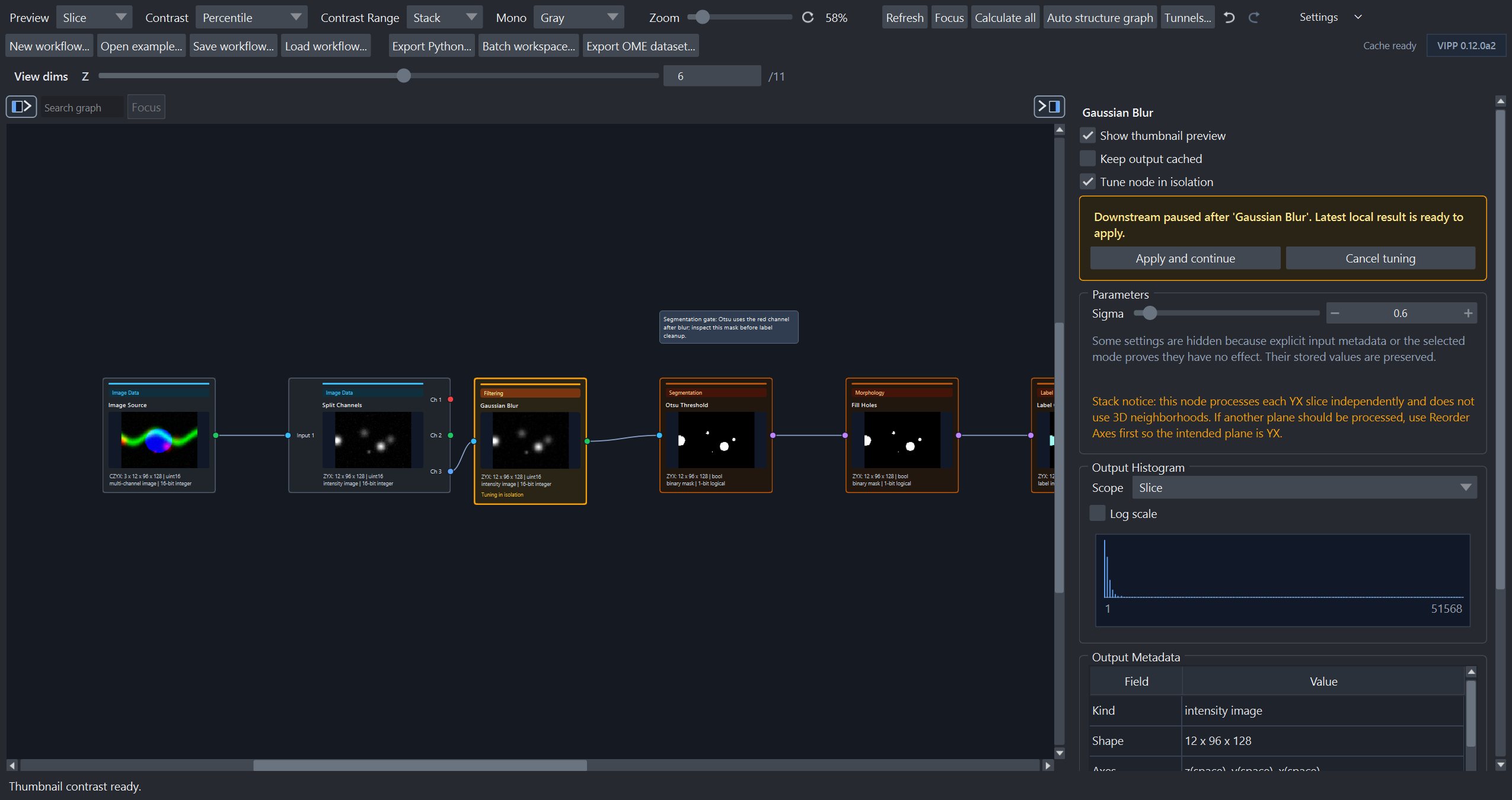
Isolated node tuning
Tune node in isolation is available from the node context menu and at the top of the inspector. The selected node must have a coherent cached result and no dirty edit, pipeline calculation, source load, or batch run may be pending or in flight. Descendants do not all need to have outputs. The command creates a persistent Downstream paused session:
- editing parameters recalculates only the tuned node;
- the tuned node remains the bright-amber actionable frontier while it needs calculation;
- downstream nodes remain dark amber and keep their last coherent cached outputs when those exist; otherwise they remain unavailable until the tuned result is accepted;
- Apply and continue reuses the latest tuned output and resumes from the direct children; and
- Cancel tuning restores the session-start parameters and cached result.
Calculate all releases isolated tuning before normal execution, including for fully automatic graphs. Applying stops a pending parameter debounce so it cannot trigger a duplicate run. Graph and history edits safely commit the active tuning session before changing the saved workflow. The isolation boundary is shared by synchronous and detached execution but is transient: it is not written to workflow JSON.
Execution feedback and progressive results
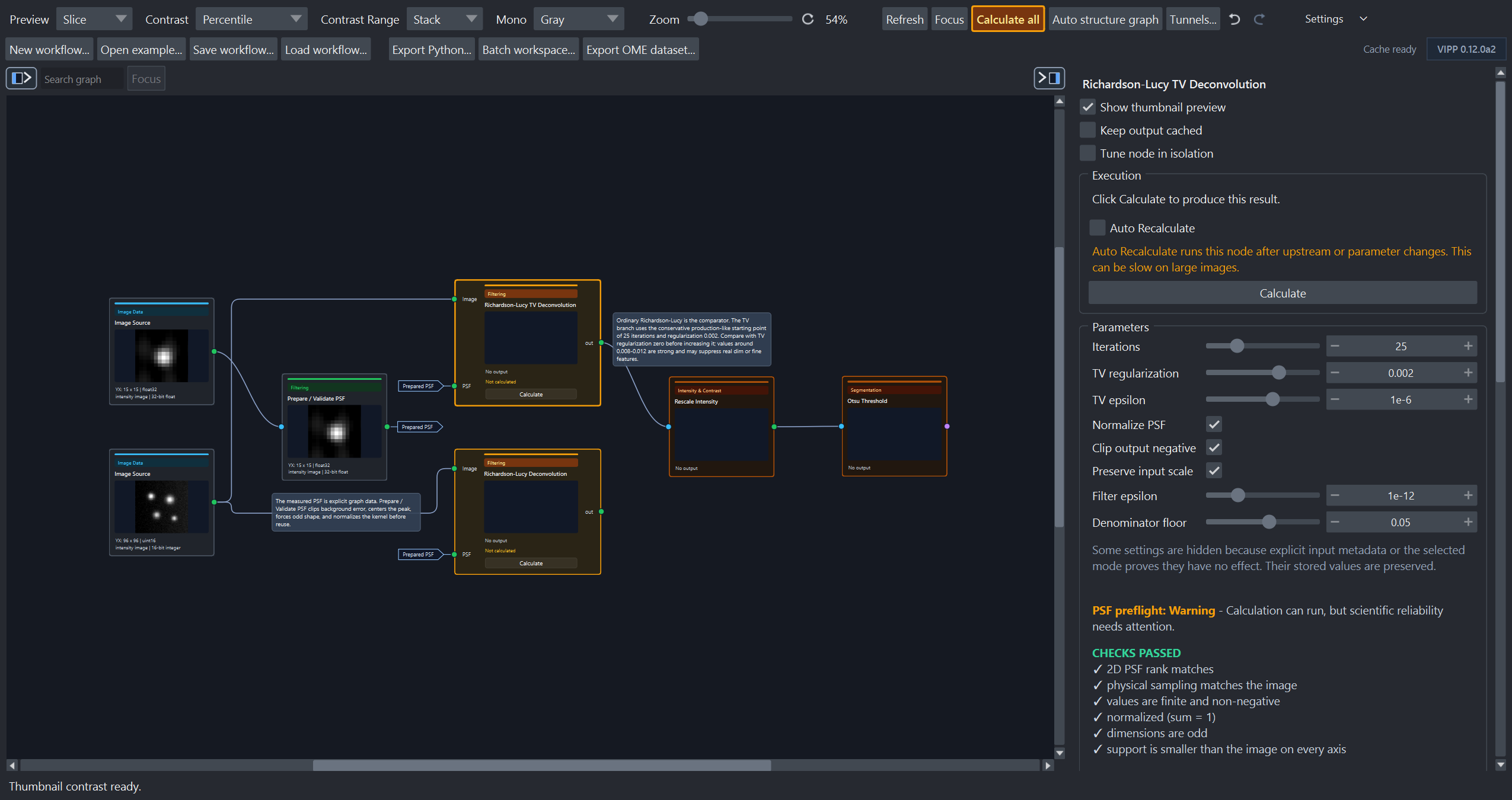
Manual nodes that have never been calculated now use the same bright-amber action styling as stale manual barriers. Calculate all also turns amber when an uncalculated or stale manual frontier needs attention.
Every stale manual/cached node acts as an execution barrier across VIPP. The actionable barrier is bright amber; stale descendants are dark amber, retain their last coherent cached outputs when those exist, and resume in dependency order after the barrier is recalculated. A descendant with no prior output remains unavailable while it waits. During a background run, each completed downstream node leaves that waiting state as soon as its result is available instead of waiting for the entire branch.
Each completed node also publishes a run-scoped thumbnail immediately. The first preview uses the exact completed pixels with scan-free display limits. These partial worker results do not enter the live scientific cache: VIPP accepts the complete run atomically, and ignores previews from stale run or source revisions.
Faster exact-pixel presentation
Inspector, pinned-label, and RGB-channel layers now use exact, non-writeable views of cached arrays instead of copying complete volumes for display. Boolean masks are converted only when a napari Labels layer requires an integer representation.
Compatible napari Image layers are reused across image/mask dtype changes and same-rank shape changes. VIPP explicitly resets mask blending, colormap, and contrast properties when returning to a normal image. It still replaces the layer when the presentation class genuinely changes, such as Image versus Labels, incompatible rank, RGB layout, or channel layout.
Reused layers invalidate stale contrast tokens. Rapid node selection rejects contrast or histogram results that belong to a previously selected output. Thumbnail inputs are reduced to display resolution before rendering, while exact stack contrast remains a background calculation and the shared progress area stays visible through post-pipeline presentation work.
Rescale Intensity now reports cutoff and voxel-processing phases. Floating-point rescaling uses bounded float64 work chunks with unchanged output arithmetic, and exact 0/100-percentile cutoffs use direct finite extrema rather than an unnecessary order statistic.
Graph port labels
Settings → Port labels provides three modes:
- Ambiguous only (default) labels ports where a wire is not self-explanatory;
- Show all labels every port; and
- Hide all removes port labels.
Visible labels reserve horizontal gutters, multi-port rows reserve vertical space, and long names are elided with the full name in a tooltip. Changing the mode resizes cards without moving manually arranged nodes. If that introduces overlap, VIPP points to Auto structure graph, whose layout uses the expanded card dimensions.
PSF and deconvolution guidance
Born-Wolf support controls now identify their user-set physical spans. PSF preflight separates three different questions instead of presenting one block of orange text:
- whether physical sampling meets a conventional widefield Nyquist estimate;
- whether the fixed support window contains the PSF tail; and
- how PSF support compares with the image extent under the current zero-outside-image boundary assumption.
Passed checks, attention items, and next actions have separate presentation. Support warnings name the affected axis and the PSF/image sample counts; boundary intensity is distinguished from intensity outside the array; and the inspector explains that Prepare / Validate PSF does not resize support. Boundary-tail mass is reported by Z, Y, and X.
A kernel as large as or larger than an image axis can still calculate. When the support equals the image size, the fully supported region is reduced to one centered output position on that axis; when the support is larger, no output position has full PSF support. Wrong rank and metadata-known sampling mismatch remain hard failures. Missing physical calibration is a warning because sampling compatibility cannot be verified; VIPP does not replace it with invented unit spacing. The diagnostic does not silently recenter, crop, pad, normalize, or resample the PSF.
Richardson-Lucy and Richardson-Lucy TV inspectors now reserve enough space for wrapped guidance and keep long preflight notes available through normal scrolling. Float fields use compact scientific notation for small non-zero values, and numeric fields retain their standard edit menu while adding Reset to default. RL-TV guidance also calls out under-convergence, feature loss from excessive TV, and the need to validate the PSF before tuning regularization.
The bundled 2D and 3D RL-TV comparisons now use 25 iterations, TV
regularization 0.002, and denominator floor 0.05. Values around
0.008–0.012 are identified as comparatively strong rather than as a default
recommendation. Reconstruction mathematics, constant initialization, boundary
handling, numerical-guard defaults, and the 0.002 TV default are otherwise
unchanged.
Compatibility and validation boundary
0.12.0a2 is primarily an interaction, presentation, and execution-feedback release built on the 0.12.0a1 scientific architecture. Workflow schema remains 3 and scientific cache publication remains atomic. Structural compatibility does not establish numerical equivalence, assay validity, or restoration quality. Revalidate representative and held-out data before relying on an upgraded workflow, especially for deconvolution and large-data paths.
VIPP remains alpha software. The public validation-status page separates current automated/synthetic evidence from real-image, performance, interoperability, and usability evidence still required.